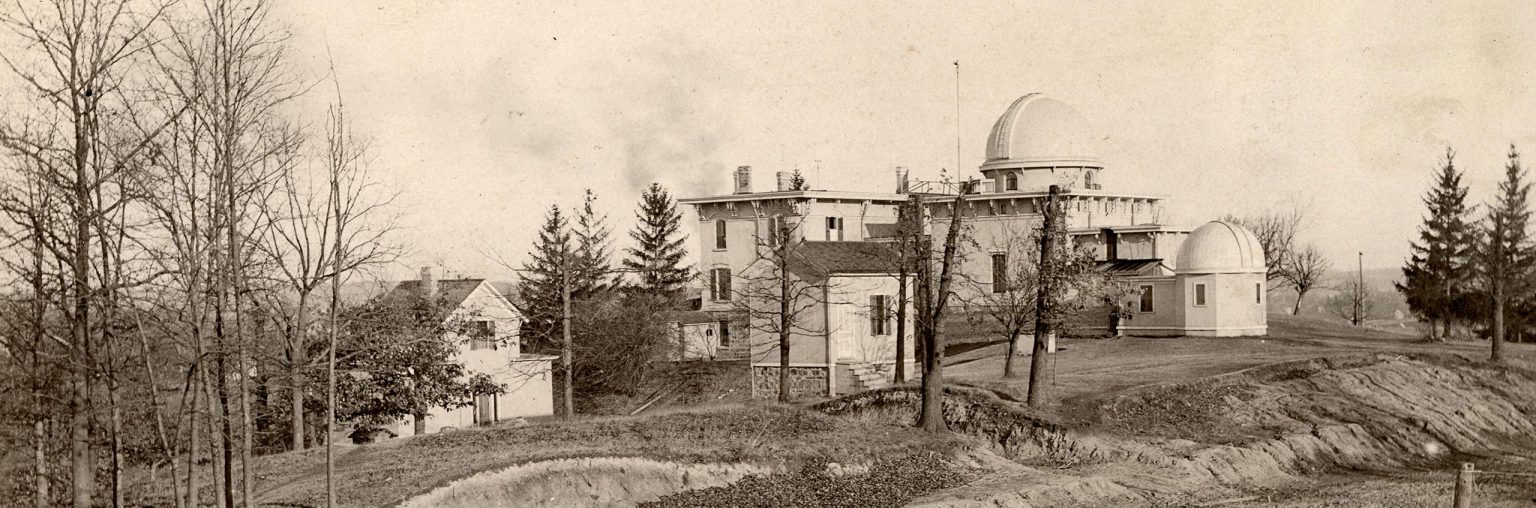
Detroit Observatory, ca. 1902 (Ralph Russell Tinkham papers, HS5888)
Tips for Searching the Database
Learn how to optimize your search to get the results you’re looking for.
Starting Your Search
Keyword searches are based on project and publication metadata. This includes information like title, author, unit, description, and format.
The History of U-M search algorithm looks for matches between keywords and project and publication metadata. This differs from internet searches, like Google, that rank results based on relevance, which is largely determined by the number of users that click on a given result.
Users looking for exhaustive results are encouraged to perform multiple searches using different but similar keywords related to their topic. For example, someone interested in Black civil rights activism on campus might perform additional searches using similar keywords, for example “African American civil rights movement.”
Types of Sources
The database contains projects and publications.
Projects are online interpretive accounts of university history. This includes exhibits, websites, timelines, and repositories. In some cases, these are online versions of physical projects or events. To set feasible boundaries for this project, this list only includes projects by the U-M community. Note that projects do not include collections of data or repositories of sources, but the project team has highlighted some commonly referenced sources on the Explore Further page.
Publications are curated from a list of secondary literature dealing with U-M history in whole or part, including academic and popular books, dissertations, edited volumes, and articles from academic journals. These were gathered from thousands of entries in the U-M Library catalog, focusing on interpretive accounts, including internally authored histories and reports, but avoiding records, directories, and articles from popular periodical media (e.g., Michigan Daily, Chronicle of Higher Education). The project team has highlighted popular periodicals with frequent articles on U-M history on the Explore Further page.
A Note on Metadata
Metadata were identified by the team that selected the resources included in the History of U-M website.
Project metadata fields were populated based on careful review of project content; the project description was written by members of the project team. Publication metadata fields were populated by the project team based largely on each publication’s listing in the U-M Library catalog.
Campus Location
Users can filter results pertaining to specific University of Michigan campuses.
Each project and publication includes a metadata field indicating the campus(es) to which it pertains: Ann Arbor, Dearborn, Flint, and/or Michigan Medicine.
A note on dates: The University of Michigan was founded in 1817 and moved from Detroit to Ann Arbor in 1837. The Medical School opened its doors in 1850, and the first University Hospital was established in 1869. The University of Michigan-Flint dates to 1956; the University of Michigan-Dearborn traces its roots to 1959.
Coverage Period
Users can filter results based on specific years.
Each project has a coverage period that defines its primary temporal focus. This includes a start and end year as determined by members of the project team. For example, a project on the history of campus anti-Vietnam War activism might have coverage dates 1965-1972, though it might include brief mention of antecedent anti-war activism on campus (e.g., World War I and World War II). Coverage period applies only to projects, not publications.
Unit
Users can filter results based on the project’s institutional author.
Each project has a unit, an associated institutional author representing the university entity under whose aegis the project exists. In some cases, it is the affiliation of the project’s creator, usually an academic department or college. In other cases, it is the entity that commissioned, sponsored, or conducted the project.